Transforming existing buildings to create new housing
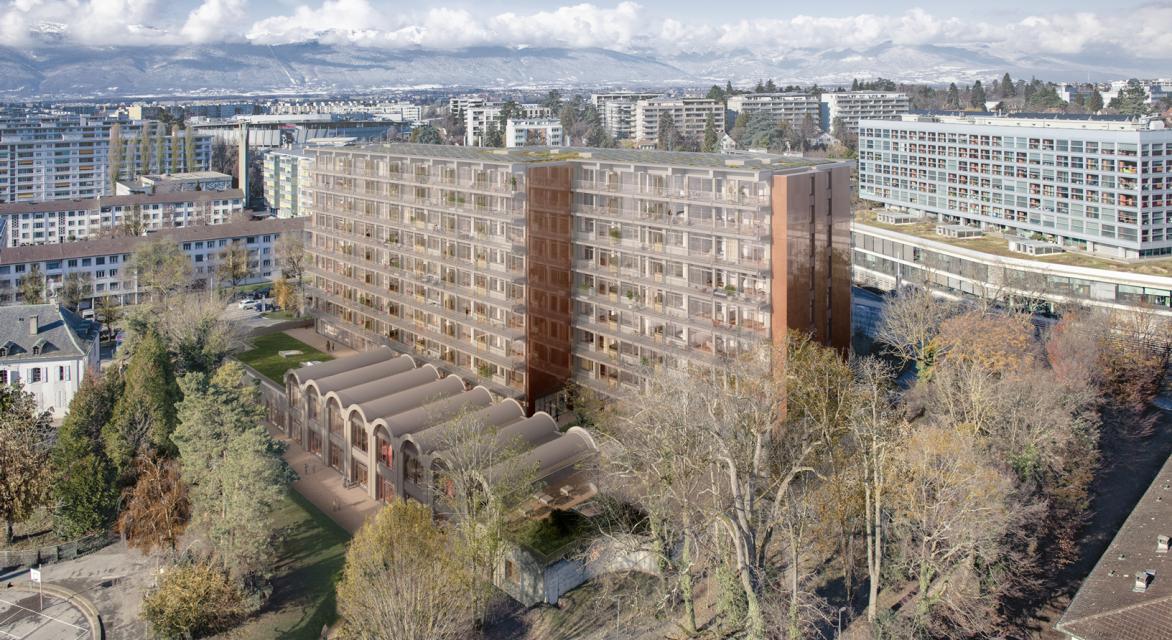
Faced with demographic, environmental, and land-use challenges, architectural innovation is emerging as a key solution. Smart densification, the transformation of existing buildings, and new forms of housing are all approaches that demonstrate how it is possible to create homes while enhancing what already exists.
In Neuchâtel, a former sugar silo from the Suchard factory has been transformed into a complex of six lofts and one studio by architect André Kuenzy. The silo retains its iconic cylindrical shape and vertical volume, while the interior offers complete freedom through custom-built storage walls, a raised platform integrating the bed, and fluid circulation throughout the space. This conversion perfectly illustrates how an industrial building can be reinvented into multiple unique living spaces, preserving its heritage identity while offering contemporary and highly personalized interiors.
https://www.letemps.ch/immobilier/visite-guidee-a-neuchatel-un-loft-delicieusement-chaleureux-dans-un-ancien-silo-a-sucre
In Baden, in the canton of Aargau, a pilot project could redefine how urban surfaces are used. Investor Christoph Schoop plans to install eight modular homes on the roof of an existing commercial building, the Fabrikpassage. These compact 1.5-room units, ranging from approximately 30 to 35 m², would be placed on the flat roof of a building that already houses a supermarket, a restaurant, and several shops. Each unit would feature its own terrace and be accessible via the existing stairs and elevator. The project is based on Wikkelhouses—prefabricated modules largely made of Swiss wood, designed to be dismantled and resource-efficient. Their construction relies on screw foundations, avoiding heavy groundwork. This approach makes use of often underutilized urban surfaces and enables the rapid creation of additional housing in a flexible and reversible framework.
https://www.watson.ch/fr/suisse/maison/311299556-une-solution-inattendue-a-la-penurie-de-logements-en-suisse
In Zurich, the Loft Apartments Rautistrasse project, designed by Spillmann Echsle Architekten, illustrates another strategy: transforming and extending existing buildings. Originally an industrial building constructed in 1947, the project preserved the structure while adding a lightweight timber extension and converting the upper floors into residential units. The building now features six floors, several of which house duplex apartments. These homes offer generous volumes and a vertical layout reminiscent of a townhouse, with internal staircases connecting levels and terraces extending the living spaces. This intervention highlights the considerable potential of reusing existing buildings in urban densification, adding housing without increasing the building footprint while preserving the industrial memory of the neighborhood.
https://www.german-architects.com/ko/spillmann-echsle-architekten-zurich/project/loft-apartments-rautistrasse?utm_
In Hofstetten-Flüh, in the canton of Solothurn, a former agricultural barn had been partially destroyed by fire. Rather than demolishing the structure, the architects chose to convert it into four contemporary duplex apartments, preserving the wooden envelope and traditional roof while reimagining the interior to create bright and functional living spaces. This conversion demonstrates how even a damaged agricultural building can become a sustainable housing solution, preserving rural heritage while meeting modern needs.
https://www.decoist.com/converted-barn-modern-apartments-switzerland/?utm_
In Geneva, the Lofts de Pinchat project, developed by Pilet & Renaud SA, transformed two former reservoirs into high-end residential units in a lush residential setting. The development focuses on open and light-filled spaces, with generous ceiling heights and spacious living areas. Designed with environmental considerations in mind, the project incorporates a rainwater recovery system, a heat pump, and photovoltaic panels, combining quality of life with strong energy performance.
https://www.pilet-renaud.ch/fr/projet/LOFTS%20DE%20PINCHAT
These five projects reflect an evolution in the way housing is conceived. They demonstrate that it is possible to densify without expanding cities, to transform rather than demolish, to make use of underutilized spaces, and to imagine more flexible and sustainable living environments. Architectural innovation not only enables the creation of new housing, but also redefines the relationship between buildings, their uses, and the territory.